I Wrote This During a Pandemic (And I Wasn’t Trying to Be Enlightened)
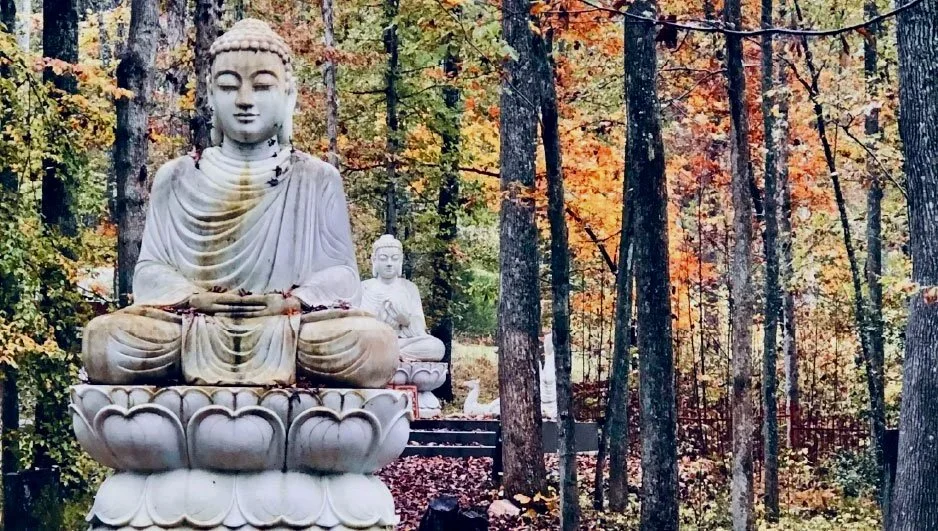
Khmer Samacky Monastery in Henrico County, Virginia.
I started this book during a global pandemic.
Life had already been doing what life does—interrupting plans, shaking foundations, piling grief on top of uncertainty. Then the world cracked open. People were dying. Systems were failing in plain sight. The names George Floyd, Breonna Taylor, and Ahmaud Arbery weren’t abstractions—they were weights on the chest. Add chronic illness to that mix, and suddenly “coping” felt like a joke people told to survive.
This wasn’t a book I sat down to write with clarity.
It was something that stewed in my head for years before I ever touched a keyboard. And even then, it came out in bursts—between work, layoffs, doubt, procrastination, and the usual mental fuckery we cling to when we’re overwhelmed.
Originally, this was meant to be a private healing conversation with myself. A way to make sense of living with rare disease while practicing Zen as a lay Buddhist. But suffering doesn’t stay neatly in its lane. Personal pain doesn’t politely separate itself from collective pain. Everything is woven together—every thread tugging on another, whether we notice it or not.
That’s one of the first things illness teaches you.
Another thing it teaches you—whether you want the lesson or not—is that compassion isn’t always easy. Especially when you’re exhausted. Especially when you’re asked to hold space for people whose conditioning causes them to do harm. We’re all interconnected, sure—but we don’t all move at the same frequency. Trauma, history, fear, and inherited narratives shape how we show up. Sometimes that conditioning traps people in loops they don’t even realize they’re repeating.
What’s strange—and still astonishing to me—is that while some patterns refuse to die, others do change. Cultures learn. People grow. Bonds form where fear used to live. Progress is uneven and messy, but it’s real. The tapestry holds all of it at once—beauty and brutality, love and confusion, rupture and repair—without canceling any single thread.
Zen practice didn’t teach me how to bypass that complexity.
It taught me how to stay with it.
Over time, I began to understand something simple but not easy: working on myself doesn’t just help me. Because nothing happens in isolation, that work ripples outward. The way I meet my own suffering affects how I meet others. Every choice, every pause, every reaction becomes another thread laid into the fabric of things. Inner work isn’t self-indulgent—it’s participatory.
A Korean Zen teaching called the Fourfold Grace talks about gratitude not as a mood, but as an orientation:
gratitude for the world that sustains us,
for those who raise us,
for all beings we live alongside,
and for the structures that allow us to coexist.
Put less elegantly: don’t be an asshole.
Extend grace—to others and to yourself.
As I’ve gotten older, one realization keeps repeating itself with obnoxious consistency:
get out of your own way.
That doesn’t mean suppressing how you feel. It means letting feelings exist without handing them the steering wheel. It means asking better questions:
Why does this hurt?
What am I clinging to?
Do I need help with this?
Zen practice didn’t magically fix my life. It did something more useful. It trained me to notice how I’m working with my mind—especially when things don’t go according to plan. It taught me that freedom isn’t about controlling outcomes. It’s about learning how to flow with what’s unfolding—without collapsing, without hardening, without pretending you’re fine when you’re not.
Stillness, I’ve learned, isn’t what happens when you drop everything and retreat from the world.
Stillness is what you practice while you’re carrying it all—while the tapestry keeps weaving itself through you.
That’s what this series is about.
It’s about illness and loss, yes—but also about trust. About loosening the grip on preferences. About recognizing that many truths can occupy the same space at the same time. About learning—over and over again—to pause, breathe, and see where you actually are inside the larger weave of things.
If you’re living with illness, if you feel lost or broken, if you’re exhausted from trying to hold it together—this is for you.
It’s also for my younger self, who thought he had to muscle his way through everything alone.
I’m not here to sell enlightenment.
I’m here to tell the truth as cleanly as I can.
To practice meeting the moment that’s already here.
To move with the fabric instead of fighting it. Moving with the Living Dharma.
We’ll take this one breath at a time.
Next up
Post #2: “The Bag of Shit (And Why Putting It Down Matters)”
Zazen, attention, and learning when to stop dragging the whole tapestry behind you.